Saturday, December 18, 2021

Spoken Walloon in Wisconsin - as noted in the 1970's

May 25, 1976 Door County Advocate
Translated by Jose Wautlet

A voyage to the home of the Walloons in Wisconsin .... first article in a series of five sent to me by Mm. J.P. Gerard. These articles were published in the paper in Namur, Belgium, after the return of the group who spent some time here last summer. I offer my translation to the best of my meager ability:

-=partial excerpt=-

Because of their citizenship, The Wallons have adopted English throughout, but meanwhile they have preserved their Wallon. It is a Wallon so pure; it is similar to the dialect of the Wallon center spoken from Jadoigne to Meux. But in the meantime, they have adapted English words when referring to of modern inventions as, "calling" on the telephone, "broadcaster" on the radio "locking the car" etc.


September 19, 1974 Door County Advocate
Belgians can't believe visitors really American
By Jose Wautlet

-=partial excerpt=-

You cannot imagine the looks on people's faces here when they hear us speak in their native language. They stare and smile unbelievingly. They cannot believe that after a hundred and twenty years of separation, we have returned here still speaking the local patois. In fact, some will not believe that we really have come from America.

Yesterday I spoke to a lovely young woman on the street In front of a market. She kept asking it again and again. Finally, I asked her to write her name and address in my notebook and promised to send her a card from America. Then she will believe!

Many of them have told us that we speak Wallon better than they do, and it is understandable. Through the years they have absorbed French words into their speech, where ours has remained the pure Belgian Wallon of this area.

Wednesday, November 24, 2021

NWTI Offers Wallon Course (1978)

NWTI Offers Wallon Course
Wed, Mat 1 1978
Algoma Record Herald

A beginners and intermediate class in the Wallon Belgian dialect will be offered as a NWTI course in the spring session to begin soon.

Classes will be at Algoma High school on Tuesday evenings from 7 to 9. Josie Wautlet, who has taught previous courses in this language, will be the instructor.

Those interested are asked to call Mary Ann Delveaux, NWTI coordinator, at 487-2580, or Mrs. Wautlet at 487-5636.

Dictionaries of the Wallon words with their English and French equivalents will be available.

The purpose of the course is to teach the understanding of the spoken Wallon language and the pronunciation of words and sentences in this language.

"We may even learn to sing some Wallon ditties." Mrs. Wautlet added. Classes will be: limited to the first 15 registants.

Sunday, November 21, 2021

Kermiss

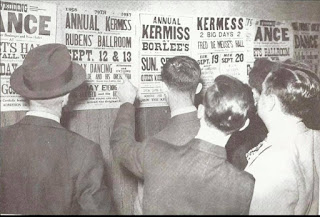
For as long as I have been alive we have spelled it Kermiss. But the tradition here in Wisconsin dates back to the first being held in Rosiere in September of 1858. As you can see by the late 1930's Wisconsin Belgian's had a couple spelling varieties (I've also seen; Kermiss, Kermis, Kermess, Kirmess) :

The proper French/Walloon spelling is Kermesse, and it sounds much like how we say it in English (Pronunciation by Pat91). The Flemish spell it Kermis.

And in case you need to review the history:

Saturday, November 6, 2021

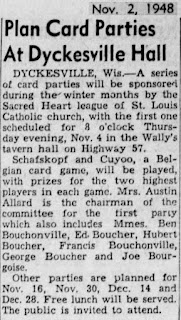
Couillon - Cooyah/cuyoo

From: Li walon po tertos

Cooyah/cuyoo is definitely "coyon/couyon" in Walloon and it is also a card game here. The original meaning is "ball, testicle".
Apparently it was used to refer to the circle used in the calculation of the scores.
You can find more information in French here for instance:
https://reglesdejeux.github.io/regles-du-jeu-couillon/index.html

(If you use "couillon" in French, it actually means "idiot")

Here in Wisconsin the popular Belgian card game has been spelled a couple different ways. Pronounced "koo yo" here, sometimes with almost a Q sound at the beginning.

Sunday, September 26, 2021

Tatoeba: Collection of sentences and translations

It might be good to review Tatoeba:

It has Walloon entries and could be used to find more Walloon natives and potentially reach out to them for info/resources

This person is apparently native Walloon? https://tatoeba.org/en/user/profile/yanagi

But sadly there are no recorded samples presently. I think this would be another good thing for a Walloon speaker to submit recordings too. I pointed out Omniglot previously.

Outside of Tatoeba, Lucyin Mahin maintains a Wallon version of Wikipedia and has contribued heavily to wikimedia.

José Schoovaerts is another person from Belgium, who is heavily interested in documenting the language.

The International Phonetic Alphabet (IPA) is a phonetic notation that is really what we need to get a number Walloon words documented in. For the few words I have heard, I usually recognize them in the non-standard phonetic written formats that various people have tried to write the lanugage in. The problem is everyone who has tried to write it has each done so a little differently. And then there are words written by various people that I have likely never heard and so I cannot really determine how one would say what they wrote.

The IPA is just as confusing and sadly really only benefits lingusitic people in my opinion. The realistic way we learn how words sound is from hearing them. So for the average person, that is what needs to be developed, a sampling of recorded words with their English and French spellings.

The is another somewhat interesting Facebook group called "Walloon lexicon." The about info says "Because I love the Walloon language, I share with you the history of its vocabulary."

Here is a recent post:

Walloon word of the day : cabasson \kabasɔ̃\
Dialectal form : (?)
Origin :
From Spanish "cabezón" (big-headed, stubborn), cabeza (head) + the suffix -ón.
From Old Spanish cabeça, from Vulgar Latin capitia, from a feminine singular of Latin capitium, diminutive of caput (head).
From Proto-Italic * kaput (head), from Proto-Indo-European * káput- (head), from * kap- (sixteen, hold), possibly of substrate origin.
-ón probably from the ending of Latin words belonging to the Third Declension (-ō, -ōnem), from Proto-Indo-European * -h₃onh₂- (?).
Meaning :
Cabesson = headrest, caveçon.

Interesting posts, but how would the words sound if spoken? Well the only real clue is that mysterious IPA representation: \kabasɔ̃\

Fortunatly there is a tool for reading International Phonetic Alphabet (IPA) notation aloud at: http://ipa-reader.xyz/

This is also good. If you use French to English, you will get the IPA for the French word, plus a sound clip of the pronunciation
http://www.collinsdictionary.com/dictionary/french-english/

French to IPA dictionary:
https://raw.githubusercontent.com/open-dict-data/ipa-dict/master/data/fr_FR.txt